
Understanding the Apple Watch Series 12 Health Sensing and Readiness
Apple has redesigned the sensor array for the Series 12, introducing a high-frequency heart rate variability metric that powers a new daily Readiness score.
Ethbase Newsroom · Published September 12, 2026 · Updated September 12, 2026
Wearable technology users have shifted their focus toward monitoring daily recovery and physical strain. Apple responded by re-engineering the hardware architecture of the Watch Series 12 to prioritize frequent biometric sampling, offering a clearer picture of how sleep and activity influence the body. These updates aim to provide a responsive look at a user's physical state instead of a simple retrospective of steps or calories.
Significant changes appear in the physical layout of the watch's underside and the software interpreting the resulting data. By increasing heart rate variability (HRV) checks and introducing a dedicated recovery score, the device adopts specialized performance metrics once reserved for professional athletic trackers. According to reporting by Engadget, these updates debuted during the recent "Surprise and shine" keynote to highlight a total overhaul of core sensing capabilities.
A Re-Architected Sensing System
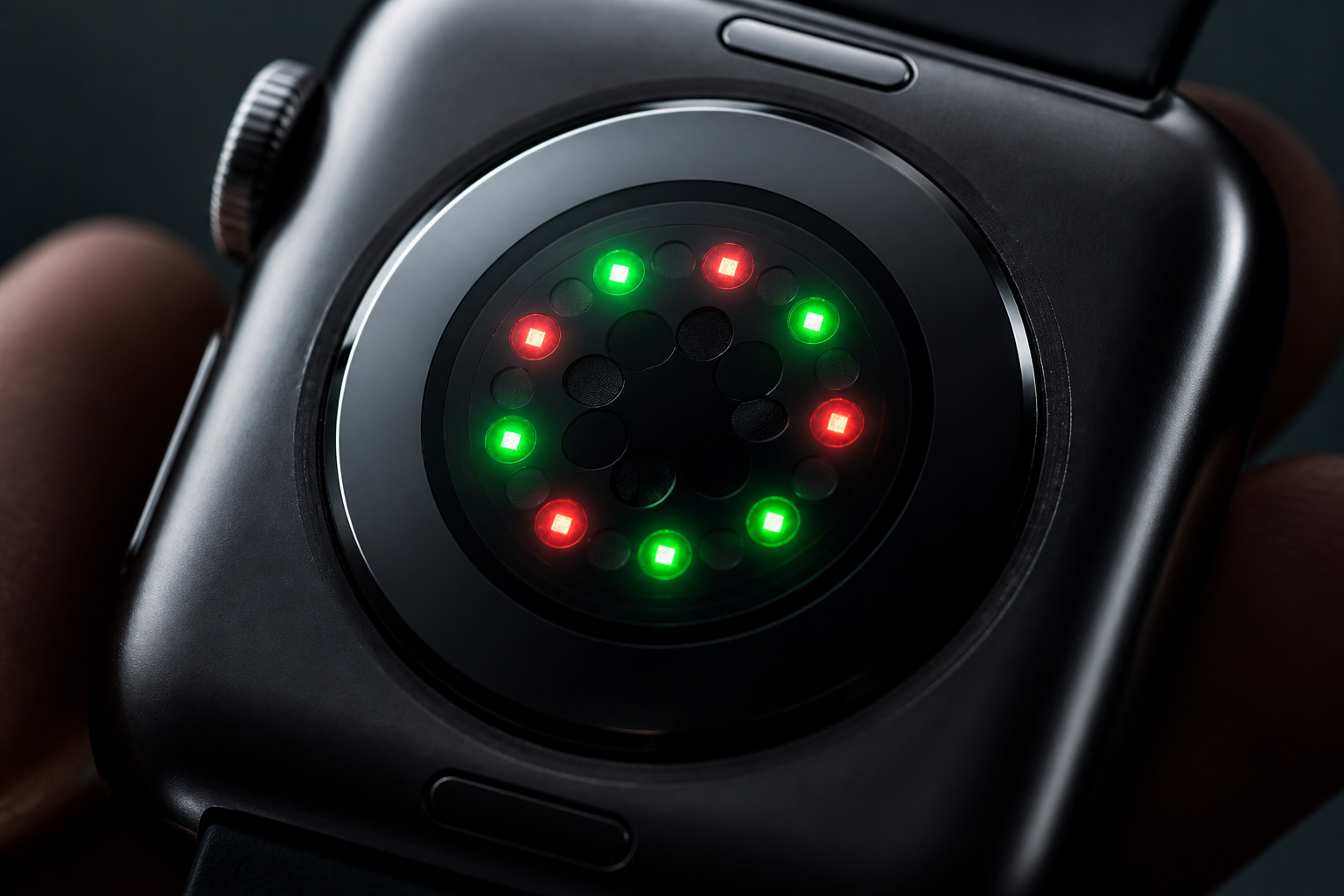
Hardware on the underside of the Series 12 has undergone a visible transformation. While the Series 11 utilized four LEDs in a diamond pattern, the Series 12 features a ring of 12 lights. This expanded array works alongside a new layout of photodiodes and electrodes to increase the surface area touching the skin.
Physical expansion allows for consistent readings across different wrist sizes and movement intensities. Apple claims this architecture, paired with higher sampling rates, creates its most accurate heart rate sensor to date. Beyond pulse tracking, the system captures nuanced data points like VO2Max and HRV with greater precision than earlier models.
High-Frequency HRV and the Readiness Score
Updated Heart Rate software tracks Heart Rate Variability (HRV) every five minutes, a practical application of the new sensor array. Older models captured this data only every two to four hours. This jump in sampling frequency provides the foundation for the new Readiness app.
The Readiness score summarizes a user's physical state on a scale from 0 to 10. Three primary pillars determine this value:
- Sleep Quality: Duration and consistency of rest.
- Activity Levels: The intensity and volume of recent workouts.
- Vital Signs: Real-time biometric data, specifically the high-frequency HRV readings.
A score of three, for example, suggests the user should prioritize rest due to poor sleep or suppressed HRV. Users must wear the device for at least seven days to establish a baseline before the system generates these scores.
Health Features and App Integration
A redesigned Health app updates the broader ecosystem with new summary tools and specialized assessments. According to the publisher page, the app uses a dynamic interface where tiles for activity, sleep, and heart metrics reorder themselves throughout the day to show the most relevant information. A new Longevity tab introduces a "health age" metric to evaluate wellbeing across seven categories.
Interactive VO2Max assessments represent another notable addition. Unlike previous versions that estimated this metric during outdoor runs, the new app provides instructions for specific movements, like jogging in place, while the watch or compatible AirPods monitor heart rate response. Users should note that the full suite of Apple Intelligence summaries requires a compatible iPhone; otherwise, the app displays the standard data layout. A reader must verify their specific iPhone model to ensure they can access the automated health summaries arriving later this year.
Audio Intelligence and the Secure Exclave
Series 12 introduces "Audio Intelligence" features powered by the S11 chip. To address privacy, the device utilizes a "secure exclave" where raw audio is processed locally. The system never stores recordings, using a 15-second rolling buffer that constantly overwrites itself.
This architecture enables Live Rewind, which provides a text transcript of the last 15 seconds of speech when a user double-clicks the dial. It also enhances the Shazam widget by identifying music the moment a user scrolls past, using the audio buffer to speed up recognition. Additionally, the watch performs sound recognition for alarms or sirens independently of a companion iPhone, serving as an accessibility tool for users who are deaf or hard of hearing.
Questions & Answers
- How often does the Series 12 measure HRV?
- The Apple Watch Series 12 measures Heart Rate Variability (HRV) as frequently as every five minutes, a significant increase from the two-to-four-hour intervals on previous models.
- What is the Readiness score?
- The Readiness score is a daily value from 0 to 10 that indicates how prepared your body is for activity, based on your sleep, recent exercise, and vital signs.
- Does the watch record my conversations for the Live Rewind feature?
- No, the watch uses a 15-second rolling buffer within a 'secure exclave' that constantly overwrites itself. The audio is transcribed locally and is not stored or sent to the cloud.
- Do I need a new iPhone to use the updated Health app?
- While the basic Health app updates are available broadly, the specific Apple Intelligence summaries require a compatible iPhone to function. Otherwise, the app will show the standard data view.