
NIH Establishes National Center to Study Brain-Body Signals
A new $3.5 million federal grant has established the Blueprint Coordination Center for Interoception Research to unify the study of how internal bodily signals influence brain function and health.
Ethbase Newsroom · Published September 30, 2026 · Updated September 30, 2026
A $3.5 million federal grant from the National Institutes of Health (NIH) will fund a new national research hub to investigate how the brain processes signals from inside the body. Headed by UCLA Health, the Blueprint Coordination Center for Interoception Research (BPCCIR) will unite various scientific fields to map how the nervous system tracks internal data.
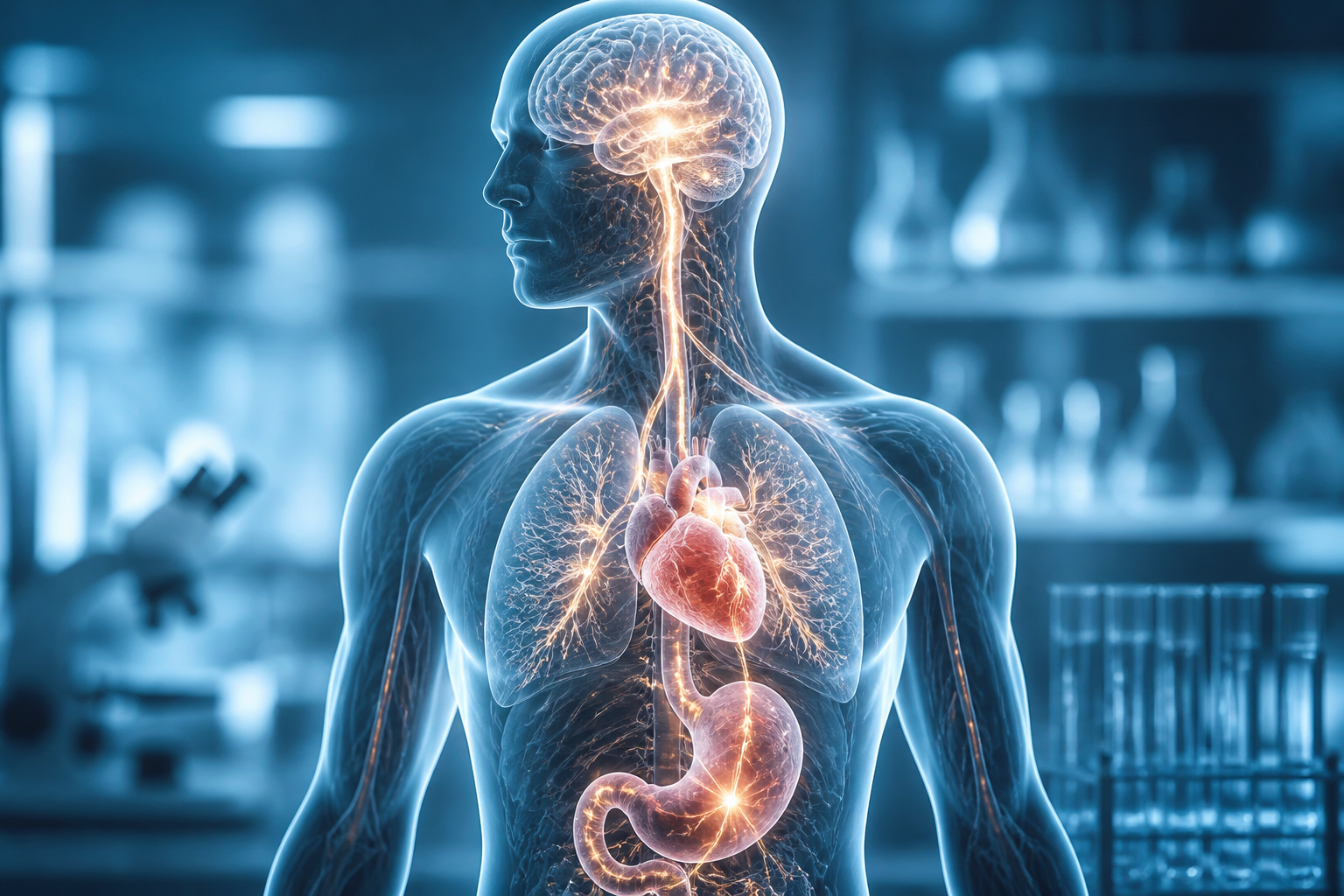
This five-year project centers on the constant dialogue between the brain and organs like the heart, lungs, and gut. By building a formal infrastructure, the center aims to replace fragmented studies with a single framework explaining how these internal signals maintain balance and drive emotions.
Mapping the Body’s Internal Signals
Interoception is the process the nervous system uses to map the body's internal state. While the five traditional senses look outward, this system monitors metabolic processes, immune activity, and inflammation. These internal check-ins are vital for homeostasis, which keeps the body stable even when the outside environment shifts.
UCLA Health reports that these brain-body interactions go beyond simple biology; they are the foundation for how humans adapt and behave. When these signals fail or misfire, the results are often linked to psychiatric disorders, heart disease, and metabolic issues. The BPCCIR will track these connections to see how internal sensing dictates overall health.
A Multi-Institutional Collaboration
Historically, research into different organ systems has happened in silos. The BPCCIR functions as a bridge to connect these isolated studies across different species and disciplines. Dr. Sahib Khalsa, a psychiatrist and neuroscientist, and Dr. Olujimi Ajijola, a cardiologist, lead the UCLA hub as co-principal investigators.
Partnering experts and institutions include:
- Harvard University: Led by Dr. Mark Andermann.
- UC San Francisco: Led by Dr. Xin Sun.
- The Allen Institute: Led by Dr. Rui Costa.
By uniting specialists in medicine, computational science, and bioengineering, the center hopes to turn molecular discoveries into treatments for patients with neurological or chronic inflammatory conditions.
Defining Interoceptive Neuroscience
People studying the biological roots of health often ask what is interoceptive neuroscience and how it varies from standard brain research. Most neuroscience looks at how we process sound, sight, or movement. This field, however, focuses on the two-way communication between the brain and the visceral organs.
Standardized data and terminology will be a priority for the BPCCIR. This ensures a discovery in a lung study can be compared directly to findings in a stomach study. To build a national community of investigators, the center will also host annual meetings and workshops focused on these internal pathways.
Building a Shared Research Infrastructure
A major portion of the $3.5 million grant supports the creation of shared scientific tools. An open-access network will allow researchers to share data and cross-species frameworks. Additionally, the center will gather experts to write consensus white papers that pinpoint the biggest hurdles currently facing the field.
Dr. Khalsa describes interoception as a systems problem. Understanding it requires connecting behavior and subjective experience to specific neural circuits. By training early-career scientists, the BPCCIR intends to turn the study of brain-body communication into a mature scientific discipline over the next ten years.
Future Clinical Impact
NIH funding is driven by the hope for new clinical breakthroughs. Dr. Ajijola noted that the center could speed up discoveries that change patient lives. Since interoceptive failures play a role in everything from heart disease to anxiety, better data could lead to new therapies or diagnostic tools.
Research today is usually split up by the specific organ under the microscope. The BPCCIR wants to view the body as a single, integrated system. By linking molecular mechanisms to clinical symptoms, the center aims to show how the body's internal state controls brain function and health.
Questions & Answers
- What is the main goal of the BPCCIR?
- The Blueprint Coordination Center for Interoception Research (BPCCIR) aims to create a shared scientific infrastructure to study how the brain and internal organs communicate, unifying research across different medical and scientific disciplines.
- Which institutions are involved in this NIH-funded center?
- UCLA Health serves as the coordinating hub, with partners including Harvard University, UC San Francisco, and the Allen Institute.
- How much funding was awarded for this project?
- The National Institutes of Health awarded a $3.5 million grant to support the center's operations over a five-year period.
- What health conditions are linked to interoception?
- Research suggests that alterations in interoceptive processes are involved in psychiatric, cardiovascular, gastrointestinal, inflammatory, and metabolic conditions.