
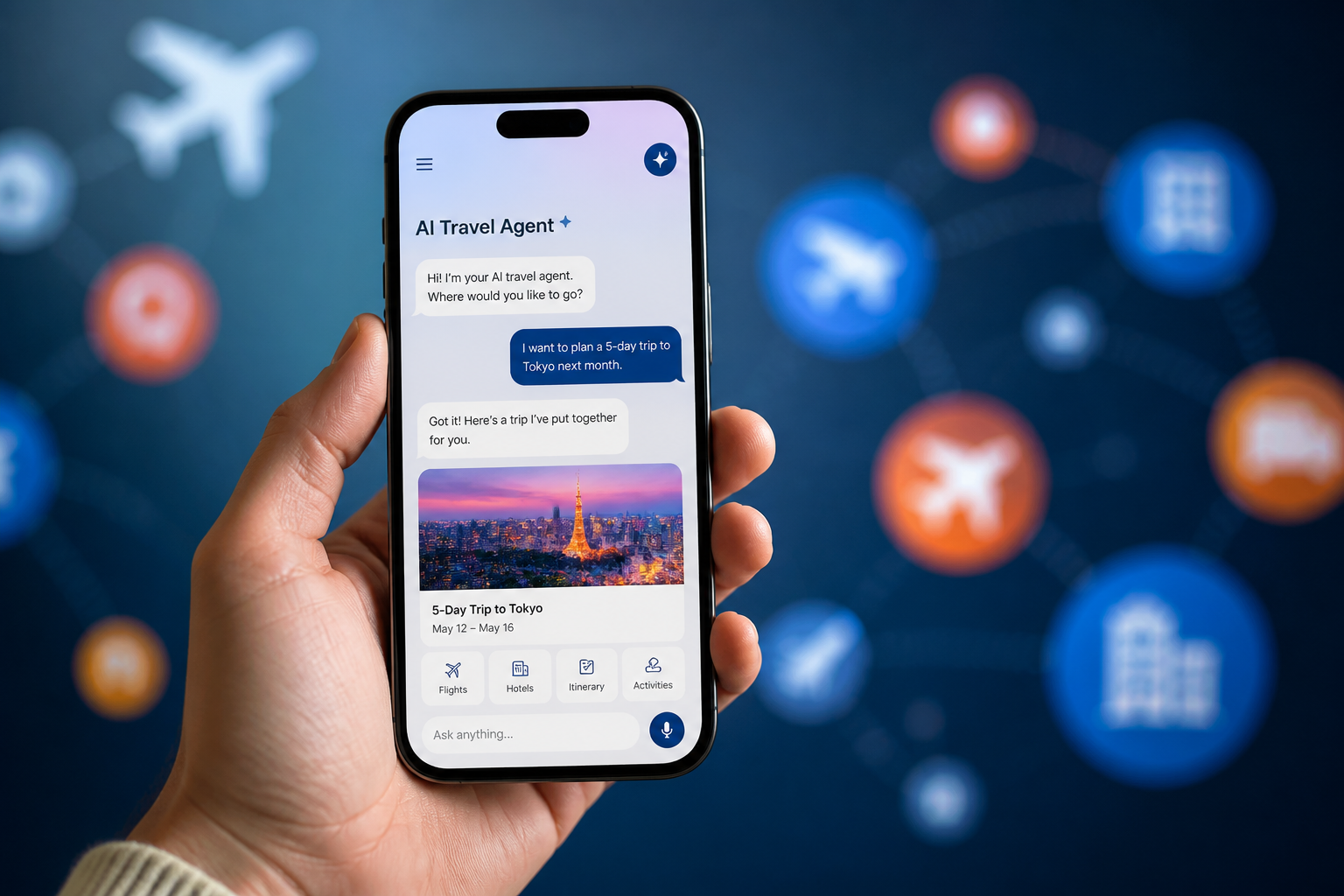
How AI Agents are Fragmenting the Travel Booking Funnel
The traditional linear path from Google search to booking is dissolving as AI agents introduce multiple entry points for travel planning and service.
Ethbase Newsroom · Published September 30, 2026 · Updated September 30, 2026
The Fragmentation of the Travel Funnel
For decades, the travel industry followed a predictable, if slightly messy, linear path. A traveler would express intent in a search box, usually on Google, and then navigate through a series of links to reach an airline, hotel, or online travel agency (OTA). Major gatekeepers dominated these early stages of discovery for years, charging billions for the privilege of visibility.
Recent reporting from the Skift Global Forum suggests this structure is coming apart. Rather than simply replacing one gatekeeper with another, AI agents like Grok and ChatGPT are fragmenting the process into many different starting points. No single company may automatically control the entire sequence of recommendation, transaction, and service in the near future.
The End of the Single Gatekeeper
The promise of generative assistants is the ability for a traveler to declare their intent once. Instead of repeating the same dates and preferences across multiple search engines and hotel sites, a traveler can tell an assistant what they need. Industry leaders now view the market as one where a traveler might start in one place, receive a recommendation in another, and complete the booking through a third party, according to reporting by Skift.
Airbnb CEO Brian Chesky noted that ChatGPT has functioned like a more efficient version of Google, directing traffic straight to specific platforms. He predicted a future of "many homepages" and numerous specialized agents rather than a single dominant portal.
Value is being redistributed across the ecosystem as the advantage of seeing intent early fades.
Specialized Agents vs. End-to-End Solutions
While the industry initially experimented with all-in-one assistants, the trend is moving toward specialization. Expedia Group CEO Ariane Gorin stated that the company has moved away from a single end-to-end agent in favor of specialized tools. Different parts of the travel journey require different expertise, and this approach acknowledges that reality.
Expedia has also identified answer-engine optimization as its fastest-growing channel. Travel companies are already pivoting their marketing strategies to ensure their data is accessible and prioritized by the LLMs that travelers are now using for initial research.
The Role of AI Agents in Travel Distribution
The integration of AI agents in travel distribution is fundamentally changing who owns the customer relationship. In the traditional model, the company that captured the initial search often held the most power. Now, the "last mile" of the transaction—handling real inventory, processing payments, and managing service recovery—is becoming the primary differentiator.
Google’s historical dominance in search never fully converted into travel commerce because it lacked this last-mile infrastructure, argued Sierra CEO Bret Taylor. Established players now aim to ensure that even if the discovery happens on a third-party AI platform, the actual fulfillment and service remain within their proprietary systems. Trust has become a scarce asset in this fragmented environment, according to Booking Holdings CEO Glenn Fogel, who noted that while LLM referrals currently drive less than 1% of room nights, direct transactions still account for the mid-60% range.
Direct Traffic and Ecosystem Strength
Some companies are using their existing ecosystems to bypass the traditional funnel entirely. Uber CEO Dara Khosrowshahi reported that most traffic for Uber and Uber Eats is now direct. This direct relationship allows the company to offer additional services, such as hotel bookings, at roughly break-even rates to strengthen its Uber One membership program.
High-frequency touchpoints allow companies to use AI to expand their utility.
By becoming a daily habit for users, these platforms can act as their own "agents," guiding users toward travel purchases without ever involving a traditional search engine.
Challenges in Service and Recovery
Fragmentation creates significant hurdles for service and reliability. When a recommendation comes from one agent, the booking happens through another, and the service is provided by a fourth, the chain of accountability becomes blurred. The industry is currently grappling with who is responsible when a reservation is lost or a flight is canceled in a multi-agent scenario.
Travelers gain personalization and efficiency during the planning phase, but the trade-off is a more complex web of providers. Verification is essential; travelers should check that the agent they are using has direct access to live inventory and clear protocols for service recovery before committing to high-value bookings.
Questions & Answers
- How are AI agents changing how people search for travel?
- Instead of using traditional search engines to compare multiple sites, travelers are using AI assistants to declare their intent once, receiving curated recommendations that often lead directly to booking platforms.
- What is answer-engine optimization?
- It is a marketing strategy used by travel companies to ensure their data and inventory are correctly interpreted and recommended by AI models and answer engines like ChatGPT or Grok.
- Who currently owns the travel customer in the AI era?
- Ownership is becoming fragmented. While an AI agent might own the discovery phase, the company that handles the 'last mile'—payments, inventory, and customer service—typically retains the financial transaction and long-term loyalty.
- Are most people currently booking travel through AI?
- No. According to Booking Holdings, LLM referrals currently account for less than 1% of room nights, with the majority of travelers still booking directly through established travel brands.