
New Classroom Policies for Screen Time and AI in 2026
As 54 million students return to K-12 classrooms, school districts are implementing strict new limits on screen time while piloting AI chatbots to assist learning.
Ethbase Newsroom · Published September 14, 2026 · Updated September 14, 2026
The Shift Toward Analog Learning and AI Accountability
American K-12 classrooms are undergoing a fundamental transformation as the 2026 school year begins. Educators for 54 million students now face a conflicting mandate: they must strip away the distractions of constant digital access while simultaneously carving out a space for generative artificial intelligence in the classroom.
NPR reports that this pivot stems from parental anxiety and a growing movement to protect the cognitive development of children. Unlike the tech-heavy pushes of recent years, the current atmosphere favors a return to analog methods for core tests and firm limits on when a student can pick up a device.
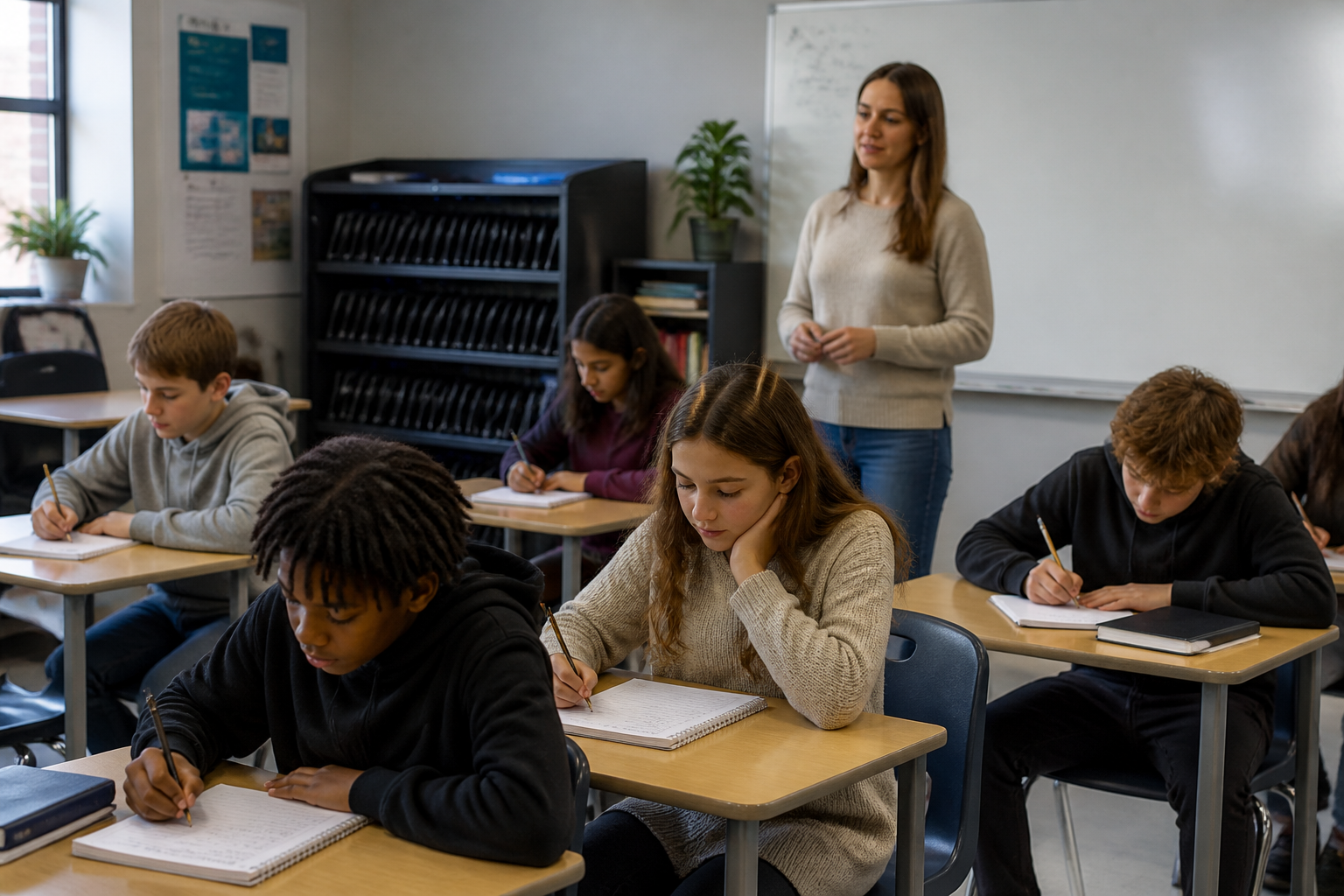
Teachers are reclaiming the physical page to prevent academic cheating.
Data from an NPR and Ipsos poll conducted last spring shows that four in 10 teachers have increased the frequency of handwritten assignments. A similar number of staff now demand that students finish their work inside the classroom to ensure no unauthorized tools are used.
Students are often the ones asking for these boundaries.
Teenagers frequently argue that AI should stay out of writing tasks entirely, according to recent reporting. When the technology is used, students have voiced a preference for rules that force them to document exactly how the software assisted their work, prioritizing transparency over a total ban.
Implementing School Screen Time Limits and AI Guidelines
Districts are looking past simple smartphone bans to address the total hours students spend staring at monitors. Los Angeles Unified has started a phased rollout of screen time limits and AI usage policies. This program started by removing screens from the youngest grades and will reach every student by the end of the school year.
Parents can track these changes through district-specific portals, according to the Ethbase newsroom. The publisher page states that parents can access these guidelines by logging into their district's student management system, where they must verify their contact information to receive real-time alerts regarding policy updates. These systems typically require a multi-step authentication process, and the page notes that users should check their local district's specific requirements, as timing for policy implementation varies by school site.
Challenges for Specialized Curricula and Accessibility
Cutting back on digital tools creates friction in subjects that live on the web. In Los Angeles, middle school science teachers pointed out that 75% of their curriculum was previously screen-based, relying heavily on virtual experiments. Moving back to physical labs creates logistical headaches, particularly for schools that do not have the budget for physical supplies.
Accessibility is the most pressing concern for families of students with disabilities.
Speech-to-text tools have proven revolutionary for students with dyslexia, often providing a necessary surge in confidence and grades. A debate continues over how to enforce general screen limits without hurting students who need those specific devices to participate in class on equal footing.
Innovative AI Pilots in Ohio
Dayton, Ohio, is taking the opposite approach by piloting AI chatbots that serve as classroom assistants. District leadership argues that being an early adopter serves the long-term interests of children, preparing them for a future job market where AI literacy is a basic requirement.
Federal Oversight and the Department of Education
Shifts in Washington have added a layer of volatility to these local decisions. The Trump administration has moved to transfer various functions of the U.S. Department of Education to other federal agencies. While staff members have been told their daily duties are unchanged, questions remain about whether a leaner workforce can still enforce federal protections through the Office for Civil Rights. Despite these administrative changes, the legal requirement for schools to provide an equitable education to all students, including those with disabilities, remains the law.
Questions & Answers
- Which school districts are leading the move to limit screen time?
- Los Angeles Unified is currently one of the most prominent districts implementing these limits, with a plan to have time restrictions for all students by the end of the 2026 school year.
- How are teachers preventing AI-assisted cheating?
- Many teachers are reverting to handwritten assignments and requiring that work be completed during class hours to ensure students are not outsourcing their thinking to AI tools.
- Are there any schools actively using AI in 2026?
- Yes, some districts like Dayton, Ohio, are piloting AI chatbots in the classroom to explore how the technology can be used innovatively to support student learning.
- How do screen time limits affect students with disabilities?
- There is concern that strict limits could hinder students who use assistive technologies like speech-to-text. Advocates emphasize that these students still have a legal right to an equitable education under federal law.