Comparing XRP and Solana's Path to New All-Time Highs in 2026
As XRP and Solana trade significantly below their record peaks, specific catalysts like the CLARITY Act and institutional ETF flows are shaping the race to new all-time highs.
Ethbase Newsroom · Published September 12, 2026 · Updated September 12, 2026
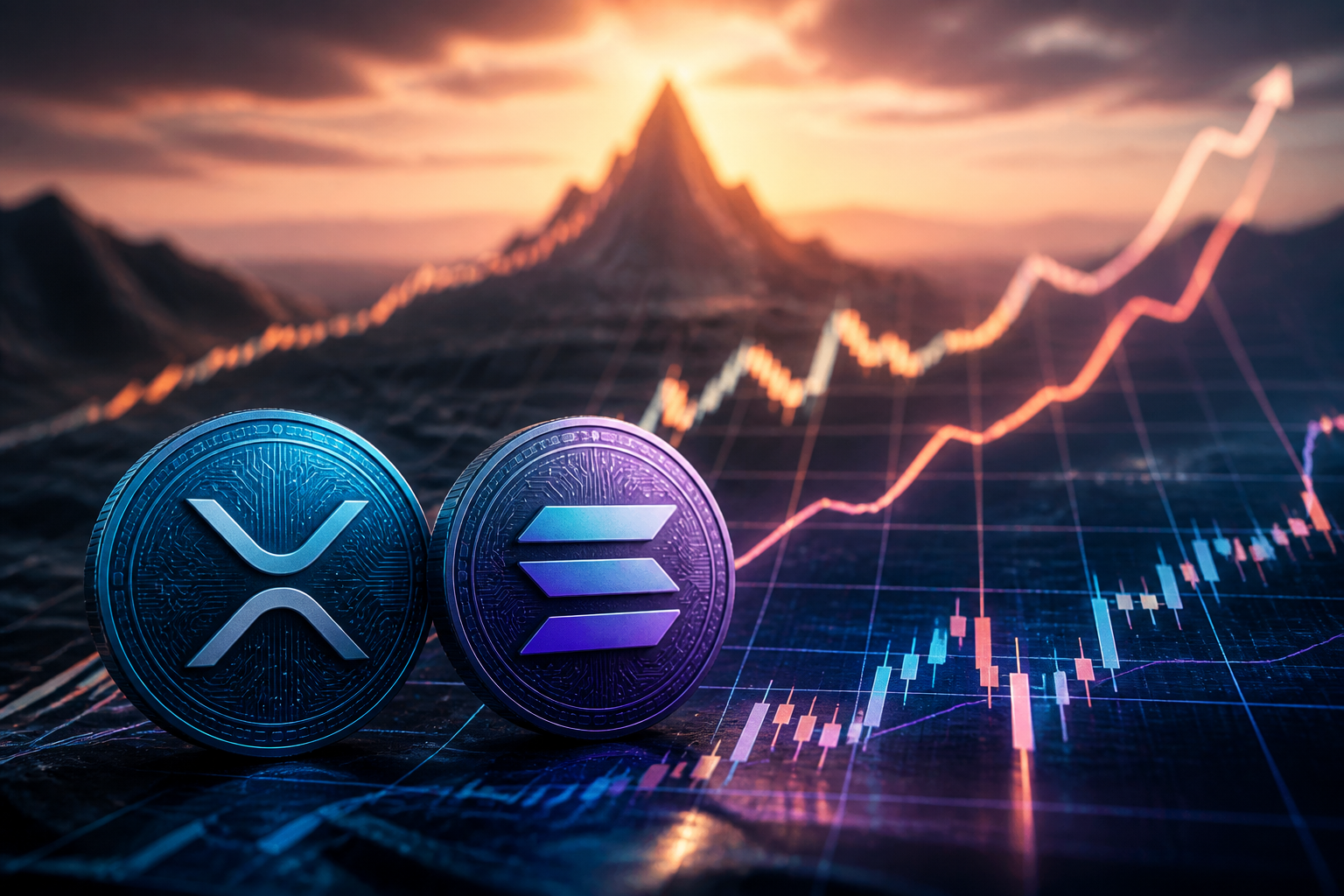
Deciding which major digital asset will first reclaim its record valuation requires a look at both mathematical hurdles and fundamental catalysts. As of September 12, 2026, both XRP and Solana remain in a recovery phase, trading well below the peaks established in previous market cycles. While both assets benefit from institutional interest, their paths to a new all-time high (ATH) rely on different structural drivers.
According to reporting by 24/7 Wall St., recent analysis using the Grok AI model suggests that Solana may have a structural advantage in reaching a new ATH first, despite needing a slightly larger percentage gain than XRP. The comparison centers on capital efficiency, regulatory milestones, and the diversity of network activity that could propel these tokens back to their former price levels.
The Math Behind the Recovery
To understand the scale of the recovery needed, investors must look at the specific price targets. As reported by 24/7 Wall St. on September 12, 2026, XRP is trading near $1.35 with a market capitalization of approximately $85 billion. To reach its 2018 all-time high of roughly $3.84, XRP would need to increase its price by approximately 2.7 times.
Solana, meanwhile, is trading between $99 and $100 with a market capitalization of $58 billion. Its all-time high, set in January 2025, sits near $295. This means Solana requires a nearly 3x move to reclaim its peak.
Although Solana's required percentage gain is higher, its lower market capitalization suggests it may require less total capital inflow to move its price compared to the more heavily capitalized XRP.
Institutional Demand and ETF Performance
Institutional adoption serves as a primary engine for price recovery in the current market. Solana has shown significant strength in this area following the launch of its dedicated exchange-traded funds (ETFs) in late 2025. Data from SoSoValue indicates that Solana ETFs have seen cumulative inflows of $1.3 billion since their inception. This consistent demand from traditional finance sectors provides a floor for Solana's valuation that was absent in previous cycles.
Conversely, XRP has demonstrated resilience in its own spot ETF products. Even during periods when other altcoin funds experienced outflows in early September 2026, XRP investment vehicles maintained steady support. This divergence suggests that institutional investors may be positioning themselves ahead of specific regulatory shifts, viewing XRP as a distinct asset class separate from the broader layer-1 market.
CLARITY Act and Regulatory Milestones
The most significant variable for XRP remains the legislative environment in the United States. The CLARITY Act is the primary catalyst for XRP, with a critical Senate cloture vote scheduled for September 15, 2026. A successful passage of this act could provide the legal certainty necessary for a rapid repricing of the token, potentially allowing it to close the 2.7x gap faster than organic market growth would allow.
Solana’s path is less dependent on a single legislative event. Its catalysts are diversified across network upgrades, high-throughput decentralized exchange (DEX) volume, and staking activity. This multi-pronged approach means that while Solana lacks a "binary" event like the CLARITY Act, it is also less vulnerable to a single point of failure in the regulatory sphere.
Forecasting XRP and Solana Through 2026
When evaluating an XRP vs Solana price prediction 2026, the mechanics of market capitalization are a decisive factor. According to the analysis provided by 24/7 Wall St., the "capital efficiency" argument favors Solana. Because Solana's market cap is roughly $27 billion lower than XRP's, each dollar of new investment theoretically has a larger impact on Solana's price per token.
Standard Chartered has issued a base-case estimate for Solana to reach $250 by the end of 2026.
While this is slightly below its $295 ATH, it illustrates the expectation of a sustained rally. XRP's path is more volatile; if the CLARITY Act fails to pass, the token may struggle to overcome the $85 billion market cap resistance, whereas a victory could see it bypass its 2018 records in a compressed timeframe. Investors must weigh the "high-beta" nature of Solana, which tends to amplify Bitcoin's gains, against the event-driven potential of XRP.
Growth in Network Activity
Beyond price speculation, on-chain metrics provide a view of the underlying demand. Solana continues to dominate in terms of active user addresses and DEX transaction volume, largely driven by its high-speed architecture and low transaction costs. This usage-based demand creates a fundamental value proposition that supports a return to all-time highs.
XRP’s ecosystem is increasingly focused on cross-border liquidity and institutional settlement. Its recovery is tied to the adoption of the XRP Ledger by financial institutions for real-time gross settlement. While Solana thrives on retail and DeFi activity, XRP’s path to a new ATH is more closely aligned with the integration of blockchain into the global banking infrastructure. Readers should verify the status of the CLARITY Act vote and monitor ETF flow data weekly to assess which asset is maintaining its momentum.
Questions & Answers
- What is the current all-time high for XRP and Solana?
- As of September 2026, XRP's record high remains approximately $3.84 (set in 2018), while Solana's all-time high is approximately $293 to $295, established in January 2025.
- How does market cap affect the race to a new ATH?
- Solana has a lower market cap ($58B) compared to XRP ($85B). This means Solana requires less total dollar inflow to achieve the same percentage price increase, a concept known as capital efficiency.
- What is the CLARITY Act and why does it matter for XRP?
- The CLARITY Act is a piece of U.S. legislation aimed at providing regulatory clearings for digital assets. For XRP, a successful Senate vote (scheduled for Sept 15, 2026) could remove legal uncertainties that have historically suppressed its price.
- Which token has seen more institutional ETF interest?
- Solana ETFs have recorded approximately $1.3 billion in cumulative inflows since late 2025. However, XRP ETFs have shown unique resilience, maintaining steady inflows even when other altcoin funds faced withdrawals.