
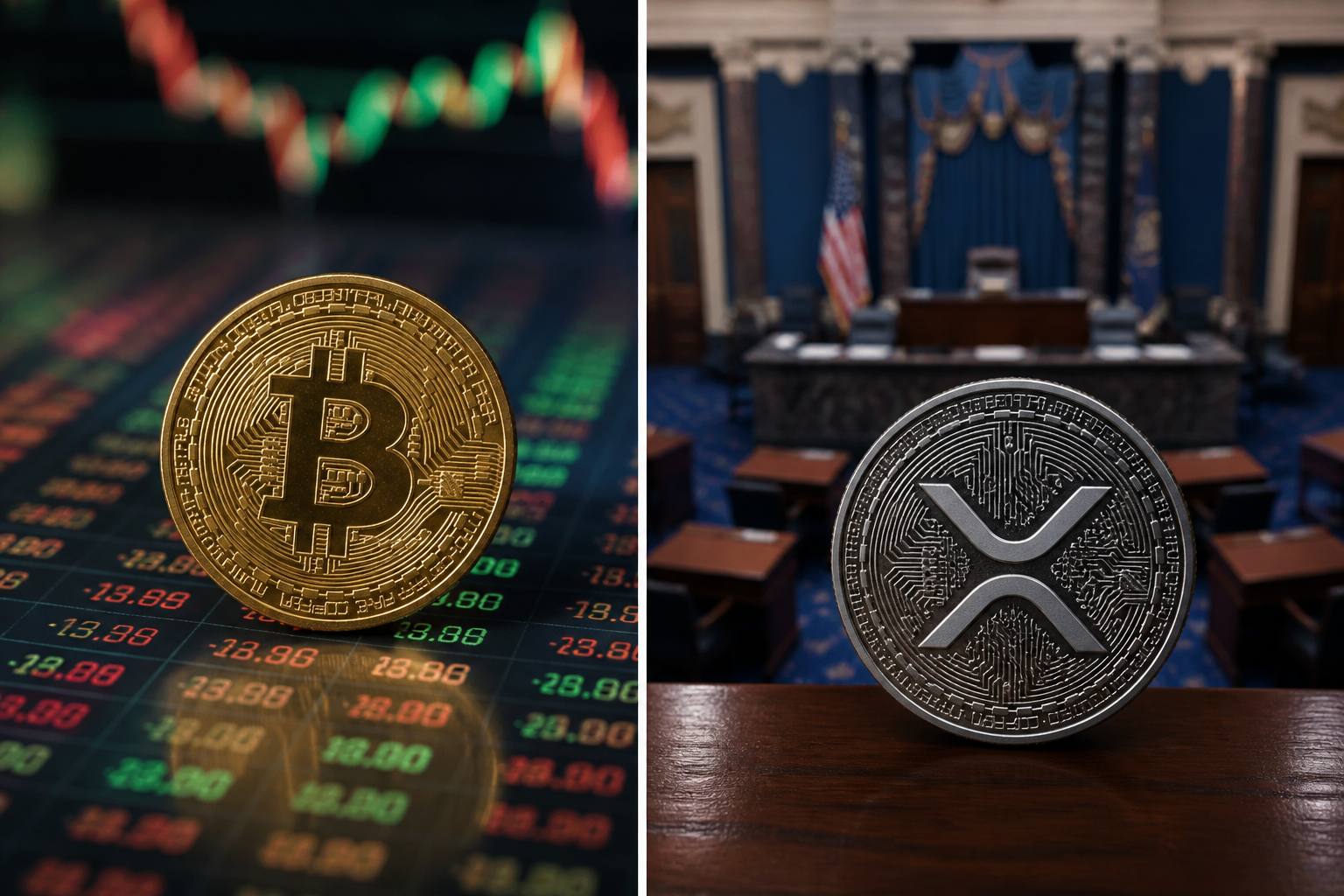
XRP vs. Bitcoin: Price Recovery Potential and the CLARITY Act
As the Senate approaches a pivotal vote on the CLARITY Act, investors are weighing XRP's high-upside recovery potential against Bitcoin's established institutional stability.
Ethbase Newsroom · Published September 12, 2026 · Updated September 12, 2026
Deciding which digital asset has the better chance of a comeback requires looking past simple price charts. While XRP and Bitcoin have both taken heavy losses over the last year, their recovery paths are being carved by different regulatory clocks and adoption rates.
As of September 12, 2026, traders are fixated on a legislative milestone that could finally pull these two assets apart. The Senate cloture vote on the CLARITY Act, set for September 15, serves as a specific catalyst for XRP that Bitcoin lacks, even though Bitcoin remains mathematically closer to its record high.
The Mathematical Gap to All-Time Highs
XRP trades near $1.35, according to reporting by 24/7 Wall St., leaving it roughly 65% below the $3.84 record it set back in January 2018. To hit that eight-year-old peak, the token needs to rally by about 184%. It is a steep climb; the asset must nearly triple in value just to make whole the investors who bought at the top nearly a decade ago.
Bitcoin's recovery profile is less extreme. At roughly $77,000, it sits 39% below its October 2025 high of $126,198. Reclaiming that record requires a 64% gain. Because Bitcoin set its high less than a year ago, the market generally views a potential rally as a return to recent norms rather than an attempt to break a stale, multi-year cycle.
Analyzing Volatility and Risk-Adjusted Returns
Recent data shows the sharp swings defining the XRP vs Bitcoin investment outlook 2026. Through September 10, XRP notched a 30-day bounce of 40%. While that shows momentum, it follows a period of heavy selling that has left the token down 53% over the last 12 months.
Bitcoin has proven more durable.
Its annual decline is roughly 30%, and its year-to-date loss stands at 11%, compared to a 25% year-to-date drop for XRP. For investors, these figures suggest that while XRP might offer faster rebounds, Bitcoin has historically provided a steadier floor when the broader market corrects.
Understanding the 24/7 Wall St. Analyst Rankings
For those weighing these tokens against traditional stocks, 24/7 Wall St. offers a specific research service. According to the publisher's page, their analysts have published a report titled "The Top 10 Stocks to Buy Now," which is separate from their crypto coverage. The page notes this report is free to access once a user provides an email address.
This program targets investors seeking specific stock picks rather than index funds. The publisher says these ten selections stem from two decades of research and are not necessarily the biggest or most famous companies. Readers should check the performance history of these picks themselves, as the page states the report is meant to help investors identify what analysts consider the best current opportunities in the market.
The CLARITY Act and Regulatory Catalysts
The Senate cloture vote on the CLARITY Act on September 15 is the main fundamental wedge between the two assets this month. The bill intends to draw clear lines between the SEC and CFTC jurisdictions over digital assets. However, the market is not betting on a quick win. Data from Polymarket shows the odds of the bill passing in 2026 have slid to 17%, down from an 82% peak in February.
Bitcoin has no similar asset-specific regulatory trigger.
Instead, its price moves are tied to the Federal Reserve’s interest rate decision on September 16. Shifts in macro liquidity usually hit Bitcoin first because of its deep institutional base, while XRP remains sensitive to the specific legal definitions within the CLARITY Act.
Divergent ETF Flow Trends
Institutional money moving through ETFs has recently shown a surprising split. XRP spot ETFs, which debuted in November 2025, have seen cumulative net inflows of $1.66 billion. By the second week of September, these funds had recorded three straight days of buying.
Bitcoin ETFs faced the opposite trend. On September 10 alone, Bitcoin ETFs saw $282.6 million in outflows, marking their third consecutive session of net selling. This suggests that even though Bitcoin is the larger asset, some institutional players may be rotating into XRP to hedge against or bet on the upcoming Senate action.
Questions & Answers
- The Senate is scheduled to hold a cloture vote on the CLARITY Act on September 15, 2026.?
- The Senate is scheduled to hold a cloture vote on the CLARITY Act on September 15, 2026.
- How much does XRP need to gain to reach its all-time high?
- Based on a price of $1.35, XRP needs to gain approximately 184% to reach its January 2018 record of $3.84.
- Which asset has seen more recent ETF inflows?
- As of September 10, 2026, XRP ETFs have seen consistent daily inflows, while Bitcoin ETFs recorded over $282 million in outflows in a single session.
- What are the odds of the CLARITY Act passing in 2026?
- According to Polymarket data cited by 24/7 Wall St., the odds of the bill being signed into law in 2026 are currently estimated at 17%.