Solana Reclaims Top DEX Volume Spot from Robinhood Chain
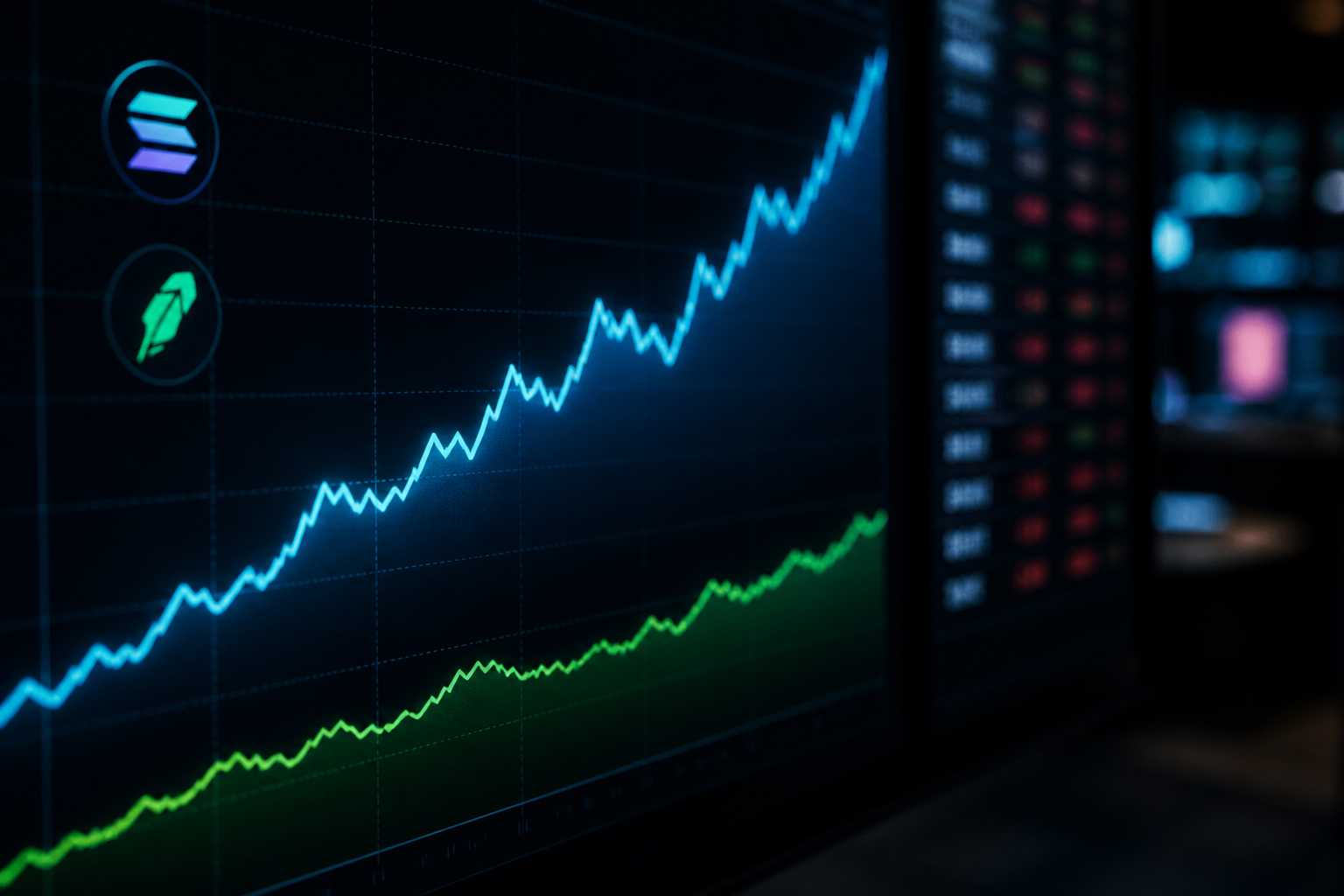
Solana has overtaken Robinhood Chain in daily decentralized exchange volume, recording $3.25 billion in activity to regain its position as the leading network for high-velocity trading.
Ethbase Newsroom · Published September 13, 2026 · Updated September 13, 2026
Decentralized exchange activity has shifted once again as established networks fight off rapid-growth newcomers. Data reported by Crypto Briefing on September 12, 2026, shows Solana has reclaimed its spot as the top network by daily DEX volume, overtaking the recently launched Robinhood Chain. Solana logged roughly $3.25 billion in 24-hour volume, while Robinhood Chain posted $2.72 billion during that same window.
This shift reverses a trend that took hold in July 2026 when Robinhood Chain first arrived. The newer network, an Ethereum Layer-2 built on Arbitrum technology, briefly led the market during the summer months.
A current gap of roughly $530 million highlights a period of stabilization for Solana, which continues to rely on its long-standing liquidity and established protocol infrastructure.
Rivalry for the Top Spot
Different approaches to decentralized finance define the competition between these two networks. Solana’s volume relies on a mature ecosystem including Jupiter, Raydium, and Orca—platforms that spent years building liquidity and the tooling required for high-frequency trading. The network has historically proven resilient through various market cycles and infrastructure challenges.
Robinhood Chain represents a newer entry that scaled to massive size in less than 90 days. Since its mainnet launch on July 1, 2026, it has generated tens of billions in cumulative volume. While speculative meme coin trading drove its initial surge, the long-term strategy focuses on integrating tokenized real-world assets and traditional equity trading within a DeFi environment.
Solana’s Tokenized Equity Surge
Growth in the tokenized equity sector has provided significant momentum for Solana lately. On September 10, 2026, a tokenized version of the dating app Grindr ($GRND) launched on the network. Crypto Briefing reports this asset generated over $31 million in volume within its first 24 hours—nearly double the $16.6 million in volume recorded by the traditional NYSE listing during the previous session.
Backpack Securities and the Sunrise liquidity protocol facilitated this performance.
Solana vs Robinhood Chain DEX volume has become a primary metric for how traditional assets move onto the blockchain. As of September 11, 2026, the total supply of tokenized equities on Solana reached $684 million, a 47% increase over three weeks. Total assets under management for these products, categorized as xStocks, surpassed $800 million during that time.
How Backpack Securities Operates
Backpack Securities provides the underlying infrastructure for these Solana-based assets for traders interested in the tokenized equity sector. Public documentation states these tokenized equities are backed 1:1 by actual US shares held in regulated custody. The settlement process utilizes standard financial infrastructure, including ACATS and DTCC, to ensure parity with traditional brokerage transfers.
Specific conditions and requirements stated by the platform include:
- Availability: These products are strictly unavailable to US persons.
- Rights: Token holders do not receive voting rights associated with the underlying shares.
- Trading Hours: Unlike traditional exchanges that operate on fixed schedules, these tokens trade 24/7 on decentralized venues like Raydium.
- Custody: Shares are held in regulated third-party custody to support the 1:1 backing.
Market Limits and Sustainability
Historical data suggests a pattern of "volume fade" despite the explosive activity seen in new launches like $GRND. Previous tokenized stock launches on Solana often saw massive initial interest followed by a significant decline in daily activity. While blockchain infrastructure can handle large bursts of equity trading, maintaining consistent liquidity remains a challenge.
Excluding US retail investors also limits the total addressable market. Since the primary pool of global equity capital cannot legally access these tokenized versions, international traders and crypto-native participants drive the current volume. Whether these tokenized assets can maintain their lead over traditional exchange volumes in the long term remains unverified.
Architecture Differences
Two fundamentally different architectures power the volume on these networks. Solana operates as a standalone Layer-1 blockchain optimized for speed and low latency. Robinhood Chain functions as an Ethereum Layer-2, leveraging Arbitrum's technology stack to provide compatibility with the broader Ethereum ecosystem while maintaining lower costs than the mainnet. This technical divide influences which decentralized applications (dApps) choose to deploy on each chain, with Robinhood Chain attracting established Ethereum tools like Uniswap.
Questions & Answers
- What was the 24-hour DEX volume for Solana on September 12, 2026?
- Solana recorded approximately $3.25 billion in daily DEX volume, reclaiming the top spot in the market.
- How does Robinhood Chain's volume compare?
- Robinhood Chain recorded $2.72 billion in 24-hour volume, trailing Solana by about $530 million.
- Can US residents trade tokenized equities on Solana?
- No, according to the reporting, tokenized equities such as $GRND are currently unavailable to US persons.
- What technology does Robinhood Chain use?
- Robinhood Chain is an Ethereum Layer-2 solution built using Arbitrum technology.
- Do tokenized stocks provide voting rights?
- No, tokenized equities on Solana are backed 1:1 by shares but do not grant the holder voting rights.