
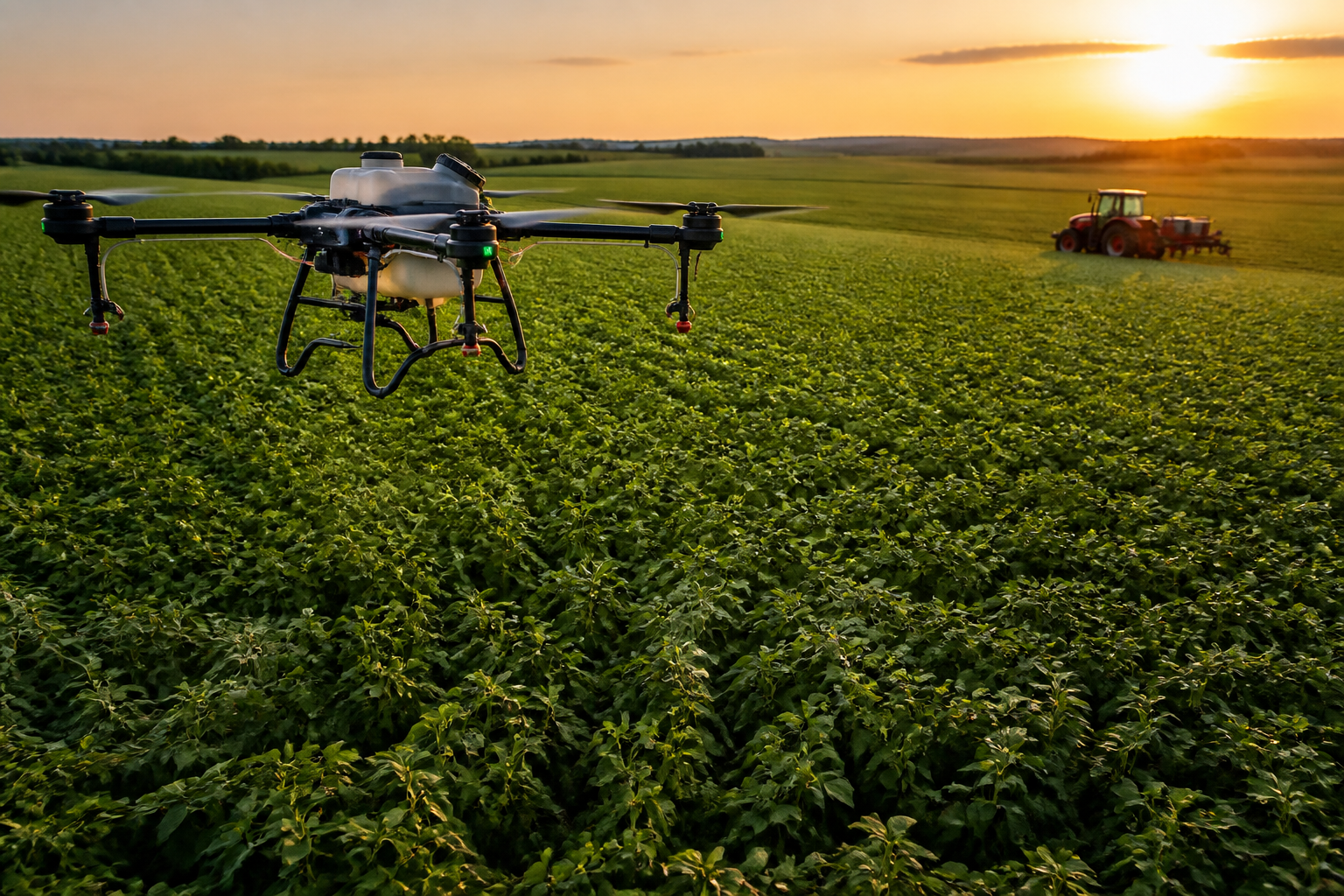
How New Drone Tariffs Impact US Agricultural Technology Adoption
Recent federal tariffs on imported drones and components are altering the economic landscape for U.S. farmers who rely on aerial technology for crop monitoring and spraying.
Ethbase Newsroom · Published September 12, 2026 · Updated September 12, 2026
New economic hurdles are slowing the integration of unmanned aerial vehicles into American fields following a major shift in trade policy. On August 13, 2026, President Donald Trump announced significant tariffs on imported drones and their components, citing national security risks tied to foreign suppliers. These measures, which mostly took effect on September 3, 2026, target the hardware that has become a staple for crop mapping and precision spraying.
Agricultural operations are facing these costs during a period of uneven adoption. While the technology promises efficiency, the price of acquisition may now stall operations that haven't yet bought their own fleets. Large-scale farms requiring heavy-duty equipment for industrial applications face the most acute financial impact.
The Tiered Structure of New Drone Duties
Trade officials are using a tiered system based on weight, capability, and origin rather than a flat rate. According to reporting by Investigate Midwest, the steepest barrier is a 100% tariff on drones weighing more than 25 kilograms (about 55 pounds). This weight class covers the heavy-lift units used to apply fertilizers and pesticides from the air.
Thermal imaging capabilities also trigger the 100% rate regardless of the drone's weight, a rule that extends to docking stations and critical components. Smaller devices lacking these security-sensitive features face a lower, but still significant, 25% tariff.
Price tags will also fluctuate based on international partnerships. Equipment sourced from the European Union, Japan, South Korea, Taiwan, Switzerland, and Liechtenstein is subject to a 15% tariff. Hardware from the United Kingdom carries a 10% duty, provided both the hardware and software originate from the U.K. or the United States. Farm managers must now scrutinize technology supply chains more closely than in previous years.
Current Adoption Rates Across US Farm Sizes
Drone adoption was already split by operational scale before these tariffs arrived. Data from the U.S. Department of Agriculture (USDA) Economic Research Service, published in "America’s Farms and Ranches at a Glance: 2024 Edition," shows that only 2% of small family farms used drones in 2023.
Midsize and large-scale family farms showed higher engagement at 9% and 12%, respectively. Larger operations typically amortize high initial hardware costs across more acreage, making the investment easier to justify. With the new Trump drone tariffs US farm technology costs expected to rise, the gap may widen between large operations that can absorb the expense and smaller farms that find the technology price-prohibitive.
Reported Benefits of Aerial AgTech
Operational advantages remain the primary draw for farmers who have already invested. The USDA report found that 40% of drone users employ the tech to increase crop yields, while another 40% use it to save labor. Monitoring large tracts of land without manual scouting allows for faster intervention when pests or irrigation issues appear.
Other reported benefits include:
- Improving soil quality or reducing environmental impacts (cited by 29% of users).
- Reducing the cost of seeds and chemicals (cited by 25% of users).
- Lowering operator fatigue by automating repetitive monitoring (cited by over 20% of users).
These efficiencies drive the market, but they are now balanced against hardware costs that have doubled for the most capable units.
Long-Term Implications for Precision Agriculture
National security goals are driving the policy shift, yet the immediate result is a change in the return on investment (ROI) for precision tools. Farmers using drones for livestock monitoring, land surveying, and crop mapping must now budget for higher replacement costs and expensive spare parts.
Industry observers expect the market to adjust, perhaps through a shift toward domestic manufacturing or a move toward service-based models where farmers hire third-party pilots instead of owning equipment. Whether domestic production can scale fast enough to meet the demand for heavy-lift agricultural drones is the central question for the 2027 growing season.
Questions & Answers
- Which drones are subject to the 100% tariff?
- Drones weighing more than 25 kilograms (55 pounds) and any drones equipped with thermal imaging capabilities are subject to the 100% tariff as of September 2026.
- How do the tariffs affect drones from the UK or EU?
- Drones from the European Union, Japan, and several other allies face a 15% tariff, while those from the United Kingdom face a 10% tariff, provided they meet specific origin requirements for hardware and software.
- What percentage of small farms currently use drones?
- According to 2023 USDA data, only 2% of small family farms have adopted drone technology, compared to 12% of large-scale family farms.
- Why did the government implement these drone tariffs?
- The administration cited national security risks associated with a heavy reliance on foreign-supplied drones and components as the primary reason for the new duties.